Z.ai Releases GLM-5.3-Flash, an MIT-Licensed Multimodal Model Served on Chinese Chips
China's Z.ai released GLM-5.3-Flash on Aug. 26, 2026, the first natively multimodal model in its GLM-5 family, under an MIT license. The 320B-parameter mixture-of-experts model activates 18B parameters and handles 1M tokens of context. Z.ai says the entire preview ran on domestic Chinese AI chips.
Chinese AI company Z.ai, also known as Zhipu AI, released GLM-5.3-Flash on Aug. 26, 2026 — the first natively multimodal model in its GLM-5 family. The mixture-of-experts model carries 320 billion total parameters, activates 18 billion per token and supports a context window of 1,048,576 tokens. Weights are available on Hugging Face under an MIT license. Z.ai said the model ran anonymously as "Ox Alpha" on OpenCode and OpenRouter for a week before launch, and that the entire preview was served on domestically produced Chinese AI chips.
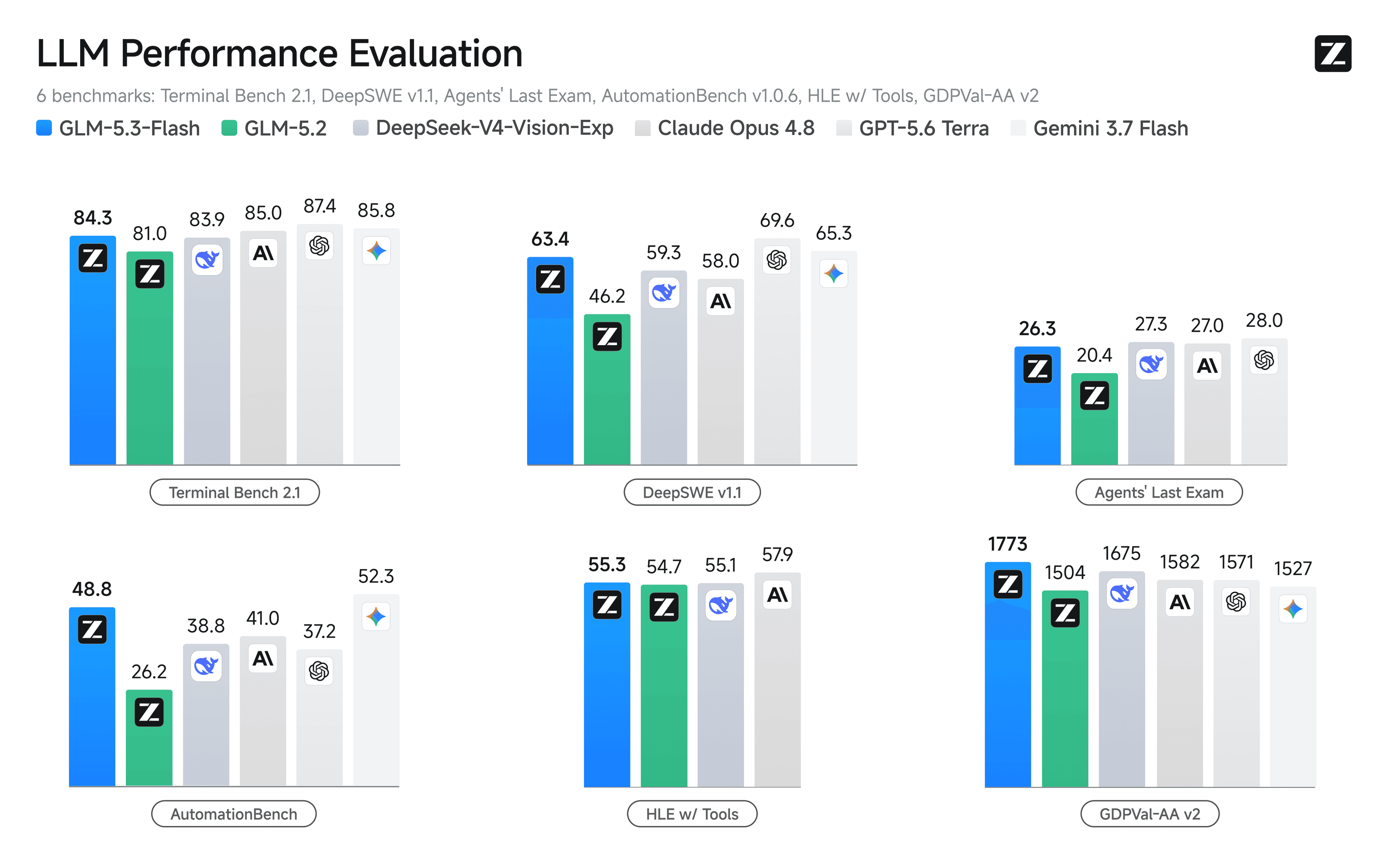
Z.ai-reported benchmarks put the model at 84.3 on Terminal-Bench 2.1, with Claude Opus 4.8 cited at 85.0 and GPT-5.6 Terra at 87.4 as reference points. GLM-5.3-Flash scored 63.4 on DeepSWE v1.1, up from GLM-5.2's 46.2, and 48.8 on AutomationBench against 26.2 for the earlier model. Independent evaluator Artificial Analysis rated it 57 on its Intelligence Index and measured 48.7 output tokens per second with a 1.52-second time to first token on Z.ai's API. Standard API pricing is $0.15 per million input tokens, $0.03 per million cached input tokens and $0.50 per million output tokens. The company noted that evaluation harnesses differ across tests, so cross-model comparisons depend on each setup.
The efficiency gains come from architecture. The model was trained from scratch on a 30-trillion-token multimodal corpus and, for the first time in the GLM series, combines linear and sparse attention — linear layers handle local dependencies while sparse layers retrieve globally relevant context. A component called IndexPool compresses groups of indexer key vectors through weighted pooling to hold down latency and memory at million-token scale, which Z.ai says yields roughly 3 times less attention compute and a 4.4 times smaller KV cache. The model also adopts manifold-constrained hyper-connections, or mHC, for scaling efficiency. The release lands in a crowded month for Chinese open-weight models: Alibaba's Qwen team shipped the 125-billion-parameter Qwen3.8-Flash-Next on the same day, and Moonshot AI announced the 2.8-trillion-parameter Kimi K3 in July.
The serving claim points to a broader debate than the model's specifications. Z.ai said it built a custom SGLang-based engine that disaggregates encoding, prefill and decoding, reporting a threefold end-to-end serving improvement across tens of thousands of domestic accelerators. That strengthens the case that Chinese labs can run near-frontier models on a domestic chip stack at a time when access to NVIDIA hardware is restricted. Separately, Beijing is reported to be weighing curbs on transferring the weights of China's most advanced models and domestic chip designs abroad, though those measures have not been finalized. GLM-5.3-Flash is live across all GLM Coding Plan tiers at 3 times the usable quota of GLM-5.3, with local deployment supported on SGLang, vLLM, TokenSpeed and KTransformers. Self-hosting remains limited to organizations with at least an eight-GPU node, since the default FP8 checkpoint is about 306 GiB before KV cache.