Anthropic Launches Claude Opus 4.7, Outperforming GPT-5.4 and Gemini 3.1 Pro Across Key Benchmarks
Anthropic has released Claude Opus 4.7, its most capable publicly available model to date. The upgrade delivers double-digit gains in agentic coding, vision, and instruction-following, surpassing GPT-5.4 and Gemini 3.1 Pro on most major benchmarks while maintaining the same pricing as its predecessor.
Anthropic released Claude Opus 4.7 on April 16, 2026, upgrading its flagship publicly available model with substantial improvements in agentic coding, vision processing, and instruction-following. The model is now accessible to Claude Pro, Max, Team, and Enterprise subscribers, as well as developers through the Claude API.
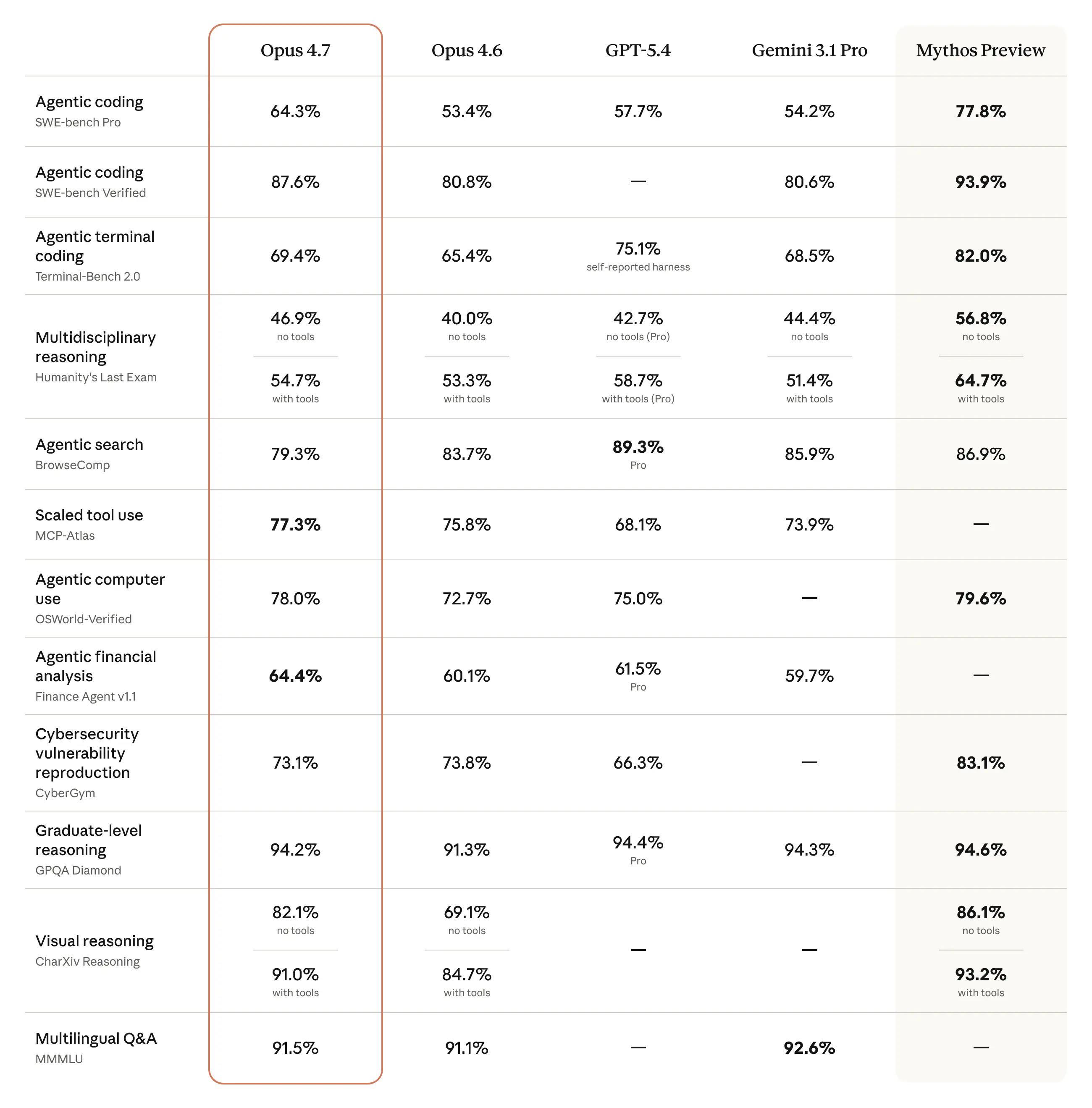
In benchmark testing, Opus 4.7 reached 64.3 percent on SWE-bench Pro, up from 53.4 percent on Opus 4.6, and scored 87.6 percent on SWE-bench Verified, surpassing both GPT-5.4 and Gemini 3.1 Pro on most major evaluations. The model processes images at resolutions up to 2,576 pixels on the long edge, representing more than a threefold increase over prior Claude models. Anthropic also introduced a new "xhigh" effort level that provides finer control over the tradeoff between reasoning depth and response latency.
Opus 4.7 builds on Opus 4.6, which launched in February with improvements in coding, task execution, and a one-million-token context window. It is distinct from Claude Mythos Preview, Anthropic's most powerful model, which remains restricted to select security and enterprise partners due to cybersecurity concerns identified under Project Glasswing. The new model also uses a redesigned tokenizer that may produce up to 35 percent more tokens for the same text, contributing to improved task performance across the board.
Pricing stays unchanged from Opus 4.6 at five dollars per million input tokens and twenty-five dollars per million output tokens, with prompt caching and batch processing discounts still available. Opus 4.7 is available across the Claude API, Amazon Bedrock, Google Cloud's Vertex AI, and Microsoft Foundry. Early-access partners including Hex, CodeRabbit, Harvey, and Rakuten reported meaningful gains in production workflows, with Hex noting that low-effort Opus 4.7 roughly matches medium-effort Opus 4.6 performance. The release arrives during what observers have called one of the busiest weeks in AI, with concurrent announcements expected from OpenAI and Meta.