OpenAI Launches ChatGPT Images 2.0 With Built-In Reasoning and 2K Output
OpenAI has launched ChatGPT Images 2.0, a new image model with native reasoning, 2K output, and stronger multilingual text rendering. Released April 21, 2026 as gpt-image-2, it is available across ChatGPT, Codex, and the API.
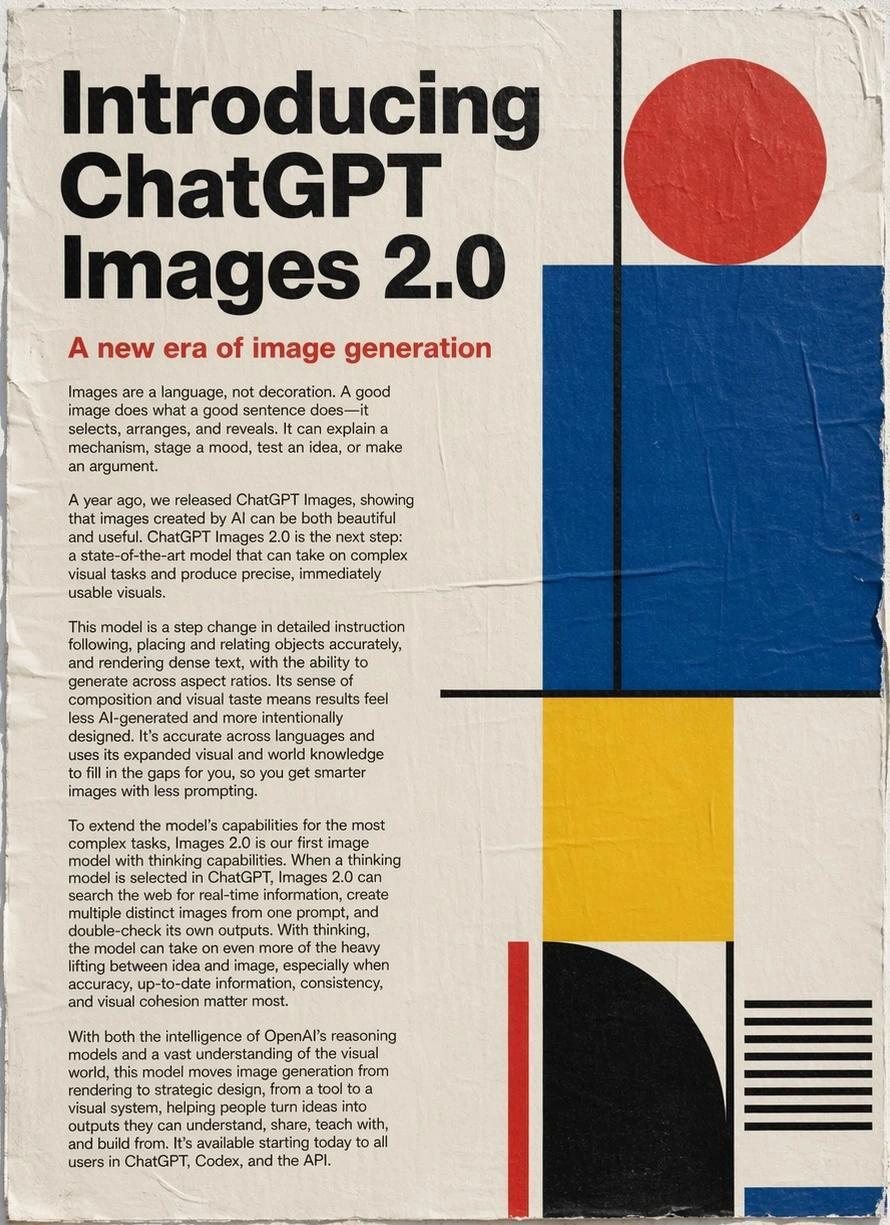
OpenAI released ChatGPT Images 2.0 on April 21, 2026, rolling out a new image generation model branded as gpt-image-2 across ChatGPT, Codex, and the API. The company is positioning the release less as a standard model refresh and more as a shift from rendering to a "visual workflow system" built for design, education, development, and content production. The base model is available to all ChatGPT and Codex users, while advanced features are gated behind paid tiers.
The system runs in two modes. Instant prioritizes fast output, while Thinking mode reasons through a prompt before drawing, verifies its own results, and can pull real-time context from the web. In Thinking mode, the model generates up to eight coherent images from a single request with consistent characters and objects across frames, a capability targeted at storyboards, manga, and multi-scene campaigns. API users can request outputs up to 2K resolution with aspect ratios ranging from 3:1 to 1:3. OpenAI's token-based pricing sets text tokens at $5 per million input and $10 per million output, and image tokens at $8 input and $30 output per million, which works out to roughly $0.21 for a high-quality 1024x1024 render in standard mode.
Text rendering is the headline technical upgrade. The model handles small text, iconography, UI components, and dense compositions more reliably than its predecessor, and multilingual performance in Japanese, Korean, Chinese, Hindi, and Bengali has improved significantly. The underlying knowledge base is current through December 2025, and Thinking mode extends that cutoff by allowing real-time web retrieval during generation. Thinking mode, extended reasoning runs, and web-aware generation are restricted to ChatGPT Plus, Pro, Business, and Enterprise subscribers, while the standard Instant mode is available on every plan, including free accounts.
The launch arrives as image generation becomes a competitive front for large AI labs, with Google's Nano Banana Pro offering similar pre-generation reasoning. OpenAI announced the model alongside Codex Labs, an enterprise training and deployment program for its Codex coding assistant, and enabled image generation inside Codex without requiring a separate API key. The company says it has strengthened safety checks to mitigate misuse risks from higher realism, filtering input prompts and reviewing outputs against policy. OpenAI acknowledged remaining limitations in precise physical reasoning, highly dense textures, and complex structural diagrams, framing them as areas for ongoing development.