

Zhipu AI Releases GLM-5.2 With 1M-Token Context Window Under MIT License
Chinese AI lab Zhipu AI announced GLM-5.2 on June 13, 2026 — a 744-billion-parameter open-source model featuring a usable 1M-token context window released under the MIT license. Designed for long-horizon agent tasks and coding workflows, the model's public API is set to launch within the week.
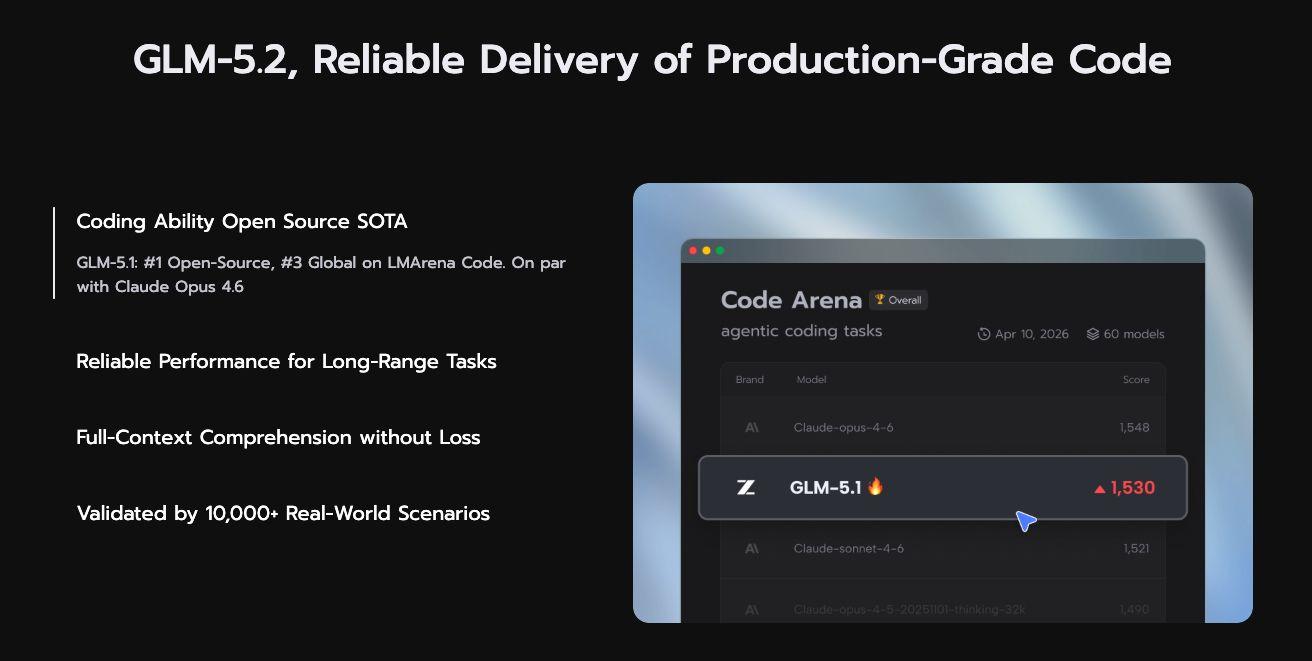
Chinese AI company Zhipu AI announced GLM-5.2 on June 13, 2026, releasing the model under the MIT license as part of what the company calls a strategy of "radical openness." Built on a 744-billion-parameter Mixture-of-Experts (MoE) architecture, the model is immediately available to subscribers of the GLM Coding Plan across Lite, Pro, and Max tiers, with a broader public API launch scheduled for the following week.
The model's headline technical feature is a 1-million-token context window that Zhipu describes as "truly usable," distinguishing it from competitors whose large-context claims often suffer from degraded retrieval accuracy over long sequences. The 1M context represents roughly a five-fold increase over GLM-5.1's 200K window and supports up to 131,072 output tokens per response. GLM-5.2 also introduces a dual thinking-effort system with "High" and "Max" modes, and serves as the primary engine powering Zhipu's domestic coding model lineup.
The release carries a clear strategic dimension. Zhipu founder Jietang framed the launch as a direct response to international access restrictions on frontier AI models, stating that "frontier intelligence belongs to everyone." The move echoes a pattern forming among Chinese AI labs: MiniMax released its open-weight M3 model with a 1M-token context window in May 2026, while DeepSeek's V4 family set a competitive benchmark in April. Together, these releases suggest a deliberate push by open-source players to fill access gaps created by geopolitical tensions around proprietary model usage.
GLM-5.2's forthcoming public API and open weights under the MIT license make it one of the more permissive frontier-class models available to date, particularly for commercial deployment. For developers seeking high-capacity, long-context inference without dependence on restricted providers, the model offers a practical alternative. As 2026's open-source frontier continues to close the gap with closed-source counterparts in terms of raw capability, GLM-5.2 positions Zhipu AI as a significant force in what is becoming an increasingly crowded and competitive open-model landscape.
.png&w=3840&q=75)