OpenAI Unveils Prism: AI-Powered Workspace for Scientific Research
OpenAI launched Prism, an AI-powered workspace designed for scientific writing. Built on GPT-5.2 and available free to ChatGPT users, the platform integrates LaTeX editing, literature research, and unlimited collaboration in a single cloud-based environment.
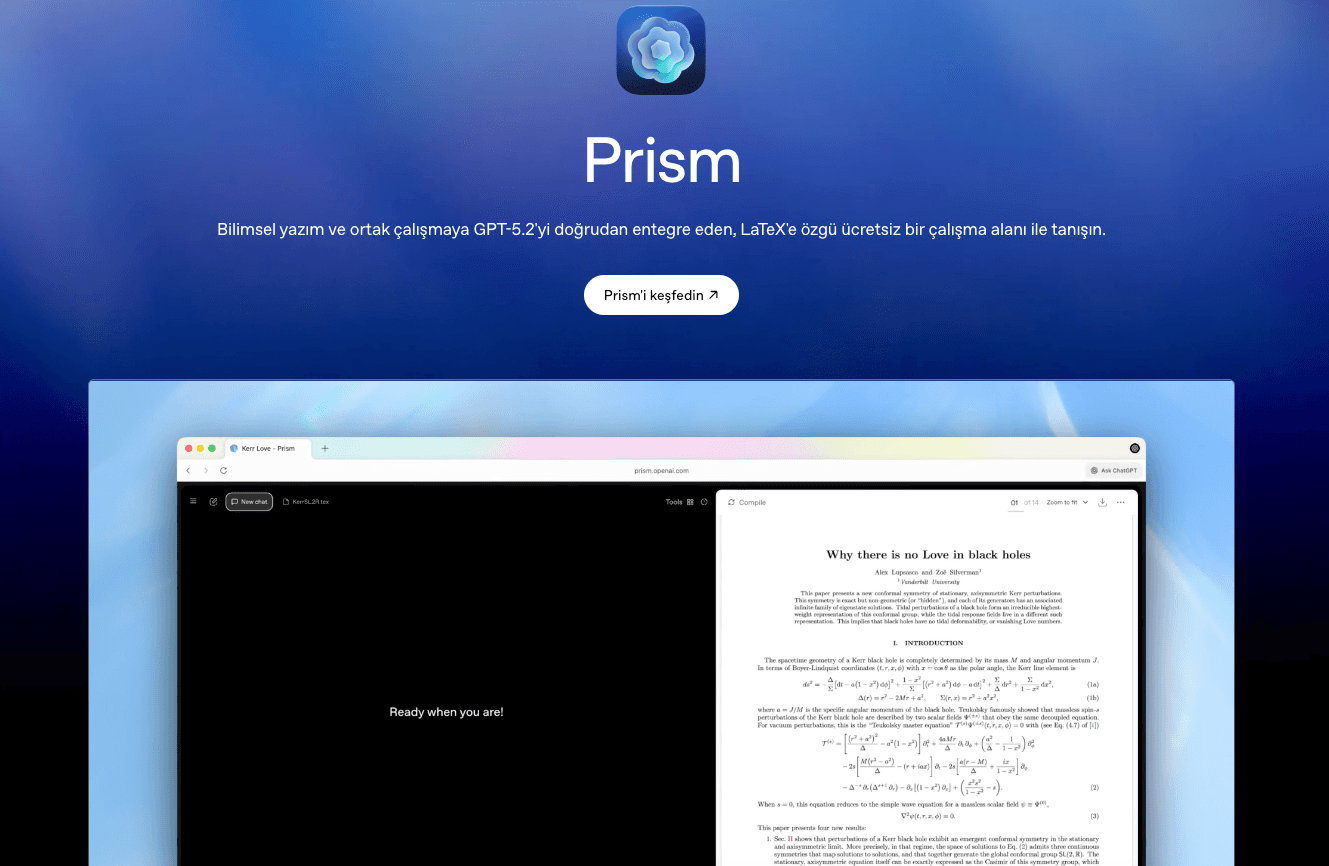
OpenAI has unveiled Prism, a revolutionary AI-powered workspace designed to transform scientific research and academic writing workflows. Built on the GPT-5.2 language model and offered free to anyone with a ChatGPT account, this cloud-based platform integrates LaTeX text editing, literature research, and team collaboration into a unified environment. Kevin Weil, OpenAI's Vice President for Science, stated at a press conference, "I think 2026 will be for AI and science what 2025 was for AI and software development," signaling the company's ambition to dominate the scientific research landscape.
The platform is built upon Crixet, a LaTeX platform that OpenAI acquired and transformed into Prism, responding to an average of 8.4 million weekly messages about natural sciences received via ChatGPT. Prism functions as an AI-based editor that enables researchers to verify claims, revise texts, search specialized literature, and convert whiteboard drawings directly into LaTeX format. The visual capabilities of GPT-5.2 allow for assembling diagrams from online whiteboard sketches, addressing a well-known pain point in scientific publishing. The system is designed to understand the complete structure of papers, including equations, figures, and overall argumentation.
One of Prism's most significant capabilities is its ability to maintain awareness of entire project contexts, including methodology, data sources, and theoretical frameworks. Researchers can utilize the platform throughout the entire workflow, from initial abstracts through publication preparation. The system offers comprehensive features including reference management, research discovery, claim assessment, and context management. Recent breakthroughs demonstrate the platform's potential: in December, a statistics paper used GPT-5.2 Pro to establish new proofs for a central axiom of statistical theory, with human researchers responsible only for prompts and verification. In mathematics, AI models solved several long-standing Erdős problems through literature analysis and novel applications of existing techniques.
Prism emphasizes unlimited collaboration without seat limits or access barriers, allowing research teams to work together in real-time through the cloud-based environment, eliminating the need for local LaTeX installations. Users can make changes directly in documents or use voice-based editing options. The platform is expected to see early adoption in mathematics, theoretical physics, econometrics, and computational biology, with typical tasks including sanity-checking derivations, clarifying notation, and translating whiteboard work into publication-ready figures. OpenAI aims to launch a "research intern"-level tool by September and automated AI research capabilities by March 2028. However, significant challenges remain, including potential citation hallucinations, oversimplification of edge cases, and privacy concerns regarding unpublished manuscripts, raising important questions about the balance between AI assistance and research integrity.