OpenAI Opens GPT-5.6 to the Public After Government Clearance
OpenAI made its GPT-5.6 series broadly available on July 9, 2026, after a limited preview on June 26. The lineup of Sol, Terra and Luna began rolling out globally following additional US government security testing.
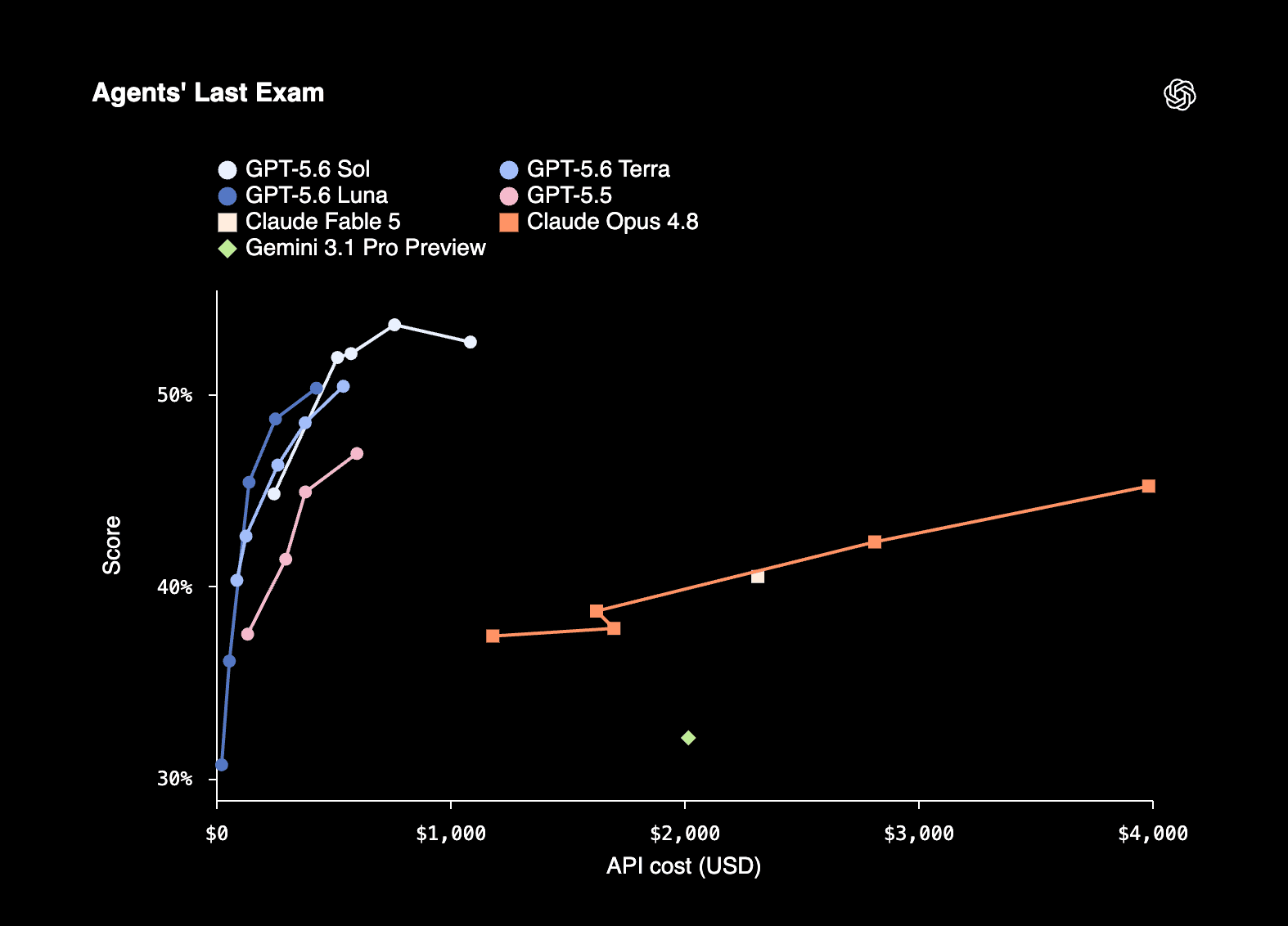
OpenAI made its GPT-5.6 series broadly available on July 9, 2026, led by its flagship model Sol. The lineup had been introduced on June 26 as a limited preview accessible only to a small number of organizations. The company said the global rollout began on July 9 and would expand gradually toward full availability over the following 24 hours. The public release became possible after the US government completed additional testing.
The series comprises three models: Sol, positioned as the company's strongest model to date; Terra, an everyday model said to deliver near GPT-5.5 performance at roughly half the cost; and Luna, the lowest-cost option in the lineup. On pricing, Sol costs $5 per million input tokens and $30 per million output tokens, Terra costs $2.50 for input and $15 for output, and Luna costs $1 for input and $6 for output. OpenAI said Sol outperforms rival models in some areas and posts top-tier results on benchmarks such as Terminal-Bench 2.1.
The release followed a delay driven by national security concerns. OpenAI had postponed the full-scale launch last month at the request of the US government, which cited worries that powerful AI systems could heighten risks of cyberattacks, intelligence operations and misuse against critical infrastructure. The Trump administration authorized a wider release after the Center for AI Standards and Innovation (CAISI), housed within the Department of Commerce, carried out additional evaluations. OpenAI reportedly sent technical experts to Washington to address potential questions in real time.
The general availability landed during an intense week for the AI race; OpenAI also introduced its GPT-Live voice series around the same time, while xAI released its Grok 4.5 model. As price pressure mounts, labs are increasingly shipping more affordable inference options. As GPT-5.6's staggered rollout completes, attention will turn to how the series' tiered price-performance models position themselves among enterprise and individual users.