Anthropic Study: AI Shows No Unemployment Impact Yet, But Young Workers Are Being Hired Less
A new Anthropic research report finds no systematic rise in unemployment among AI-exposed workers, but reveals a notable slowdown in hiring of workers aged 22–25 in high-exposure occupations. The study also introduces a novel metric called "Observed Exposure" that combines theoretical AI capability with real-world usage data.
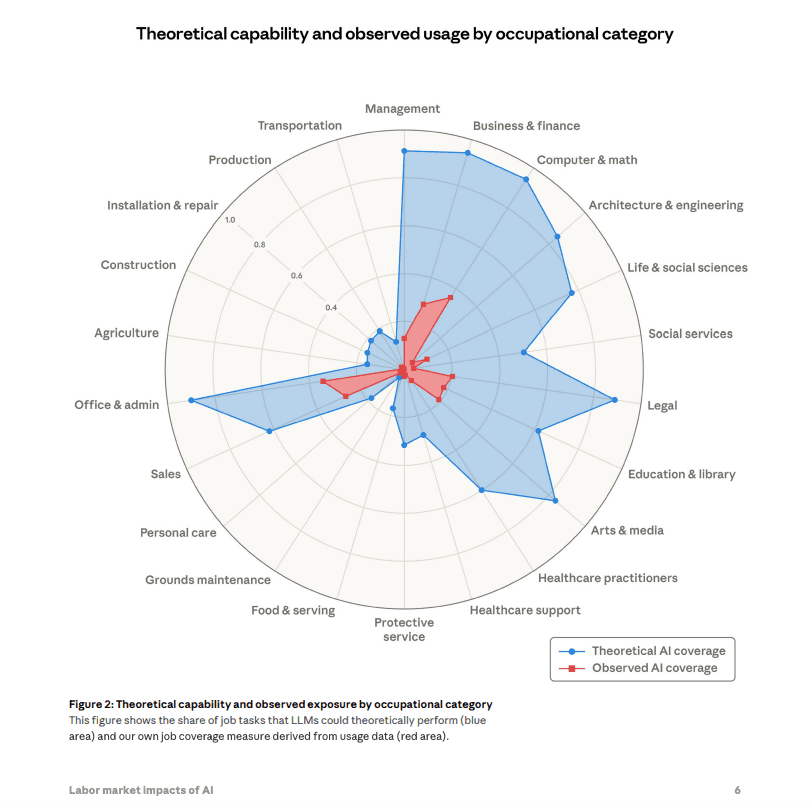
Anthropic published a new research report on March 5, 2026, introducing a novel metric called "Observed Exposure" to measure how artificial intelligence is affecting the labor market. Unlike previous approaches that relied solely on theoretical AI capability, this metric combines real-world usage data drawn from Claude conversations with task-level feasibility scores. Authored by researchers Maxim Massenkoff and Peter McCrory, the report maps AI displacement risk across approximately 800 occupations using data from the O*NET database, the Anthropic Economic Index, and exposure estimates from Eloundou et al. (2023).
The study reveals a significant gap between what AI can theoretically do and what it actually does in practice. While 94% of tasks in Computer and Math occupations are theoretically feasible for large language models, Claude currently covers only 33% of those tasks in observed usage. The ten most exposed occupations include computer programmers at 74.5% coverage, customer service representatives at 70.1%, and data entry keyers at 67.1%. At the opposite end, about 30% of workers — including cooks, motorcycle mechanics, and bartenders — registered zero coverage, as their tasks appeared too infrequently in the data to cross the minimum threshold. Notably, occupations with higher observed exposure are projected by the Bureau of Labor Statistics to grow less through 2034, and workers in the most exposed roles tend to be older, more educated, female, and higher-paid.
On the central question of unemployment, the findings are cautiously reassuring. Comparing workers in the top quartile of AI exposure to those with zero exposure, the researchers found no statistically significant increase in unemployment following the release of ChatGPT in late 2022. The difference-in-differences analysis showed a small positive shift in the gap, but one that remains indistinguishable from zero. The authors caution that this does not mean AI is having no effect; rather, any effects may be too gradual or diffuse to appear clearly in aggregate unemployment data just yet — more akin to the slow-burning disruptions of the internet era than the sudden shock of a pandemic.
However, the report does identify a potentially important early signal among young workers. Entry into high-exposure occupations among workers aged 22 to 25 declined by roughly half a percentage point per month, translating to an estimated 14% drop in job-finding rates in the post-ChatGPT period — a result that is just barely statistically significant and absent among workers over 25. The authors note several alternative explanations: young people may be staying in existing jobs, pivoting to different fields, or returning to school. The broader takeaway of the report is methodological: by establishing this analytical framework before large-scale effects have emerged, future researchers will be better positioned to separate genuine AI-driven labor market disruption from background economic noise.